TARA: Tibetan Devī of Compassion
Click the Play button above, focus on the center and sing along.
Green Tara Mantra
Om Tare Tuttare Ture Soha
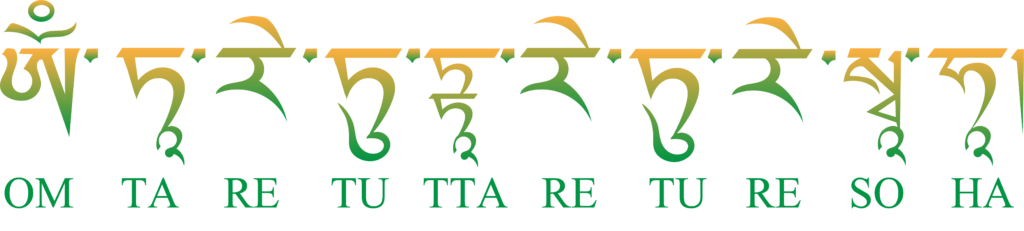
To Tara, To You Tara,
Oh Swift One, Blessings.
Tara is a name that appears in many spiritual traditions, and this particular Tara comes from Tibetan Buddhism. She is the embodiment of compassion, and takes on 21 forms to represent different aspects of compassion. For example, Green Tara, whose mantra you see and hear here, emphasizes the quality of the swiftness of compassion. I created this design from the Tibetan alphabet spelling the Green Tara mantra, also in the Tibetan Language. You can sing along and amplify the vibration of compassion in your own life.
The Essence of Compassion
Where does compassion come from? What is its nature? When you feel compassion, where in your body does it begin to well up? In the current state of the United States, there are campaigns to eject certain types of people from its borders, and it is in that very differentiation that compassion breaks down. Compassion brings us all into a welcoming circle of beings that don’t require restrictions of any kind. But why do we have it? Clearly not all beings in nature possess this quality.
I spoke to several spiritually inclined friends about this. One friend answered simply and powerfully that compassion is our true nature; it’s just the ego that blocks it from flowing freely. Another friend correlates compassion with those whom we identify with. There is a circle of loving concern that we draw around ourselves, and we have compassion for those within that circle. That circle could be just ourselves or include our family and loved ones, or demographic identities. That circle can expand all the way out to all beings, and then our compassion knows no boundary. I personally love both of these points of view. Do you have another take?
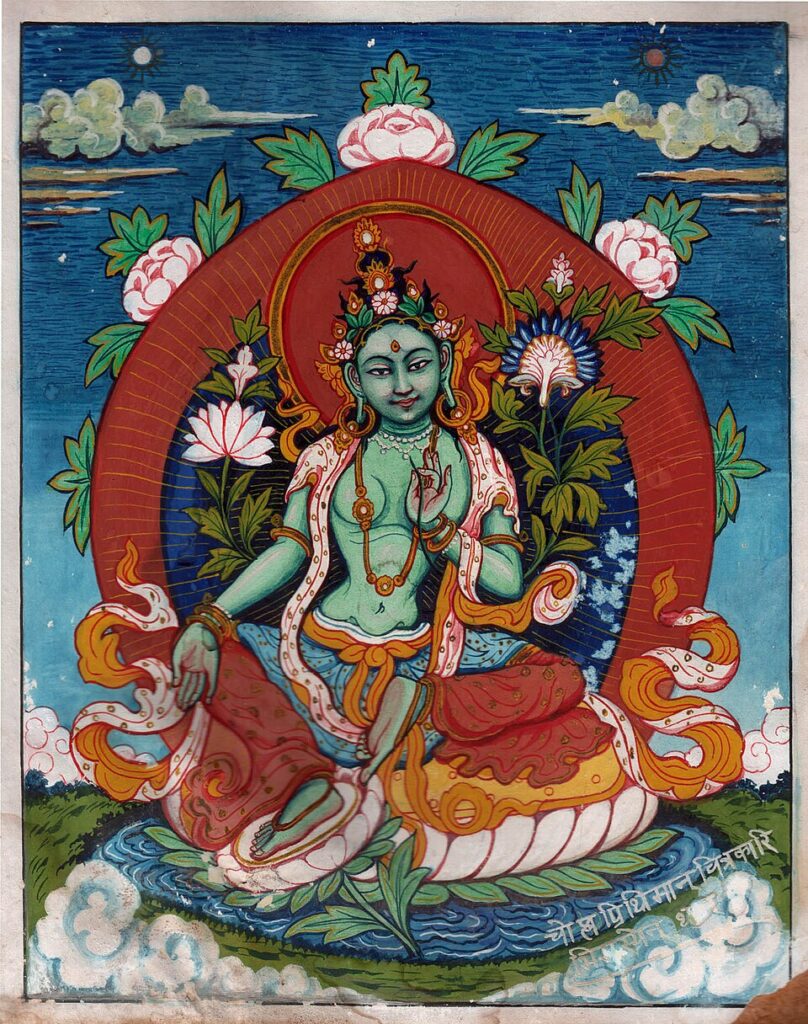
Painting of Buddhist goddess Green Tara by Prithvi Man Chitrakari done in 1947.
Embodiment
I also like to pay attention to where compassion settles in my body, how my heart open when I chant to Tara or practice compassion with others. The mere act of bringing awareness to our bodies seems to amplify the positive vibration. We can sing to Tara to help us remember our true nature, allow it to grow from our heart outwards into the world, and inspire us to take action to care of each other. The more we steep in compassion, the more it grows.
The Invisible Story
There’s a watering hole in Massachusetts that I love so much. It’s deep enough to stand in the water up to my neck. The water moves so slowly that I can’t tell by touch that its flow contributes to the gentle of rapids that begins just 10 yards downstream. Compassion seems like that sometimes; it happens every day yet is practically unnoticeable. Compassion can have its place in epic stories, but it is much more prevalent in the instances that it wouldn’t occur to share with anyone else: letting someone trying to turn onto a busy road from a parking lot, curbing the impulse to express your frustration with a new employee just learning the ropes, running an errand for a loved one because you see how little time they have, and on and on. Some day, many lives from now, I’ll hopefully cultivate compassion for people who violate the natural law of alternating cars when two lanes merge into one.
The Reunion with the Other
It’s interesting to note that compassion implies a separation between yourself and the recipient of your compassion. There is an instance that implies differentiation: you and the other. And then there’s the act of compassion, which blurs that sense of separation. I can actually feel the border between myself and another begin to dissolve at such times.
You can learn more about Tara and listen to my demo here.
You can buy a shirt with this design on Etsy here.